Death to Caps Lock

Caps Lock Troll KeyI’m not the first person to complain about this, and I certainly won’t be the last, but Caps Lock really needs to go. Since the advent of the Internet, typing in all caps has been a sign of screaming, anger, trolling and sheer laziness. In one way this is a blessing. The Caps Lock key often asks as a sort of “Scarlet Letter”, marking idiots on the Internet and making them much easier to ignore. But as a writer, I still hate this key, mostly because of its placement right next to the letter A.

Seriously guys, can’t we move Caps Lock up to the top row of keys, where I won’t hit it all of the time while typing? I’m sure there are utilities that could help me reassign it on my own computer, but this is the kind of thing that should be standard on any machine.

Sometimes I wonder if capital letters on their way out, anyway. There are plenty of languages that don’t use them, and with the advent of smart phones, typing capital letters is even harder than before. Perhaps one day caps will be limited to period fonts and antique signage. Until then, lets make it a little harder to type in all caps.

How Wikipedia Works

Wikipedia Rubiks CubeWikipedia is a marvel of the modern world. The basic idea is so insane, it’s a wonder that it works. An encyclopedia that anyone can edit? It’s an idea as ridiculous as “Abraham Lincoln: Vampire Hunter”. And yet it works. Not only does it work; it succeeds. In an age dominated by the banality of Facebook and Twitter, how does such a complete reference work ever get created?

The big secret of Wikipedia is this: it’s not quite as open as it seems. It was more free-wheeling in the beginning, but as Wikipedia’s editors have created a (relatively) complete product. The encyclopedia has been maintained by a much smaller user base. The modern website is maintained by a small cadre of geeky editors, with only the illusion of freewheeling openness.

This system works very well. It allows unregistered users to either fix typos or vandalize pages. If they fix typos, the changes stay; if they vandalize, the page is reverted by a robot or seasoned editor. That’s how an encyclopedia that “anyone can edit” can compete and beat old tomes like the Encyclopædia Brittanica. Wikipedia works because it filters out mistaken and malicious contributors, all while staying open to people who really care about increasing the net knowledge of the world.

Food Deserts and Organic Superstores

Junk Food Market logoOne thing you see more and more nowadays is a separation of healthy and unhealthy food. Modern slums have become “food deserts”. In these food deserts, there are no good grocery stores. People living in there, many without reliable transportation, have to get their food from convenience stores and fast food restaurants. This means that they don’t have access to fresh meat and dairy and produce. Forget organic food; many poor people in this country have trouble getting conventionally grown produce. They say that an apple a day keeps the doctor away, but what happens if you have neither an apple nor a doctor?

How do food deserts arise? As mom and pop grocers have given way to large supermarket chains, the supermarket corporations have become increasingly reluctant to build in “bad” neighborhoods. While this is doubly true of “healthy” chains like Whole Foods and Trader Joe’s, it also applies to conventional grocery stores like Kroger, Albertson and Safeway. Even the ubiquitous Walmart has been reluctant to build stores in the worst neighborhoods.

For people in these food deserts, junk food the only choice. First Lady Michelle Obama has been working to change this, but progress is slow. So next time you resolve to eat healthier, try to remember that some people don’t have a choice in the matter.

The Corporate States of America

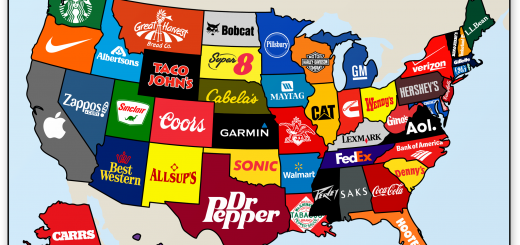
The Corporate States of AmericaThis is a map of “The Corporate States of America”. For each of the fifty states (and the District of Columbia), I selected a corporation or brand that best represented the states. My criteria are subjective, but in each case, I tried to use a brand that a) is based in that state and b) is still in business (as of 2012).

I created this map after writing an article about corporate feudalism. My hypothesis is that, as corporations and non-governmental organizations grow in power, the power of nation states will become increasingly irrelevant. We’re already seeing this on a small scale, as people turn to the Internet to make friends, instead of befriending their neighbors. I think that, as corporations become the dominant organizations on Earth, people will start thinking of themselves as citizens of Apple or partisans of Starbucks.

One thing I discovered while writing this article is that corporations are not evenly distributed across the country. Some states, such New Mexico, Alaska, Montana and West Virginia, simply do not host many big corporations. Others host so many that choosing one was difficult. In these cases, I went with the company that I though best represented the state, rather than the biggest or most notorious. Hence, I used Dr Pepper for Texas instead of ExxonMobil.

What do you think of my selection? Are there brands that you’d rather see on there?

Helvetica

Helvetica Written in Arial

Helvetica written in Arial. This drives graphic designers and font geeks crazy. No one else cares.

Graphic designers really like Helvetica. For the last 60 years or so, this font has dominated the world of visual communications. If you have an iPhone, you look at it everyday. Even if you don’t, you’re almost guaranteed to see it on everything from nutrition labels to corporate logos. In short, Helvetica is the most overused font in history.

Helvetica is a sacred cow amongst graphic artists. It’s the only font I know of with its own feature-length film. I’m not exactly sure why designers have such a fetish for it, but if I had to guess, I’d say it has to do with the way the font is perfectly balanced. It’s well-designed, no doubt, but the real magic is its unobtrusiveness. Helvetica is bland. It’s the perfect lettering for any designer, simply because it doesn’t stand out. That’s why it’s so popular, and that’s why I don’t particularly care for it.

Apple products, from Macs to iPhones, have come preloaded with Helvetica for years. But Microsoft Windows doesn’t come with it by default; it comes with Arial. Arial is similar enough to Helvetica that the average person can’t tell the difference, but it’s different enough that it stands out as an eyesore to font geeks. Arial has the same basic letter forms, but it’s not quite as balanced or as unobtrusive as Helvetica. And that’s why it drives font geeks crazy.

Helvetica remains one of the greatest typefaces of all time, though I’d really like to see it used less. It’s overplayed, like a six-month-old pop song on the Top 40. Moreover, graphic designers’ reliance on it hinders innovation in typefaces and encourages lazy, bland design. Don’t get me wrong; Helvetica has its place, but there are a thousand other fonts that I would rather use.